
Brush Clearing in the Salt Lake Valley
Take back overgrown property. Woods edges, ditches, fence lines, vacant lots. We finish the job and leave it looking like land again.
Quick Answer
Take back overgrown property. Woods edges, ditches, fence lines, vacant lots. We finish the job and leave it looking like land again.
When the brush wins
Gambel oak, Russian olive, Siberian elm, juniper, tamarisk. The woody stuff that turns a walkable property into a wall in a few years. We clear it to the ground, grind it into mulch in one pass, and leave land you can step onto again.
Most of the brush problems we see along the Wasatch Front come from the same short list: Gambel oak — scrub oak, if that's what you call it — Russian olive, Siberian elm, juniper, and tamarisk along the water. Gambel oak is the big one. It spreads as a clonal thicket from its own roots, so a bench lot that had scattered oak brush ten years ago is a solid wall today. And with cheatgrass filling in underneath, every acre of it is wildfire fuel.
Mowing doesn't touch it. A bush hog hits the top three feet and leaves the woody canes standing. Chainsaw work kills a few plants at a time and leaves the roots. Chemical spraying works on some species and not others, and it takes a season to see the result.
A forestry mulcher on a skid-steer grinds the whole mess — stems, limbs, leaves, root crowns near the surface — into mulch chips in one pass. When we leave, you can walk the line. Most customers come back and want a maintenance pass the next year because after the first clear, keeping it clear is easy.
How We Do It
All the woody stuff
Gambel oak, Russian olive, Siberian elm, juniper, tamarisk, chokecherry — gone. Including the surface root crowns that make it come back.
We don't quit halfway
When we leave, the job is done. No 'we'll come back for the rest.'
Set up for maintenance
Want a yearly pass to keep it from coming back? We'll lock you in on the calendar.
Work right up to the edge
Fences, ponds, driveways, creek banks — we clear to the boundary without damaging what's on the other side.
When landowners call us for brush clearing
- Gambel oak thickets that have turned a bench lot into a 10-foot wall
- Woods-edge cleanup behind a yard or pasture
- Ditch banks and irrigation laterals clogged with Russian olive and tamarisk
- Vacant lots the city is sending letters on
- Defensible-space brush cutting around homes near the foothills
- Scrub oak thinning around homes and cabin lots
- Pond and lake shorelines overgrown with brush
- Acreage parcels being prepped for sale or listing
How the job runs
Tell us what you're fighting
Photos and rough dimensions are enough. We can usually identify the main invasive species from a picture and quote the job.
Walk the property with us
Free on-site estimate. We walk the line with you, flag anything that stays, and quote it flat.
One-pass clearing
The mulcher grinds the brush and the surface root crowns. No burn pile, no lingering stumps.
Optional maintenance cycle
Most customers put us on a yearly or every-other-year pass. Cheaper than a fresh clear and the brush never wins.
What it costs, and why
Brush clearing is priced per acre at forestry-mulching rates, starting at $1,000 per acre for lighter work. Small jobs (under a half acre) are priced per project since mobilizing the machine is the fixed cost. We're happy to bundle small brush jobs with neighbors to share the trip fee.
Why the equipment matters
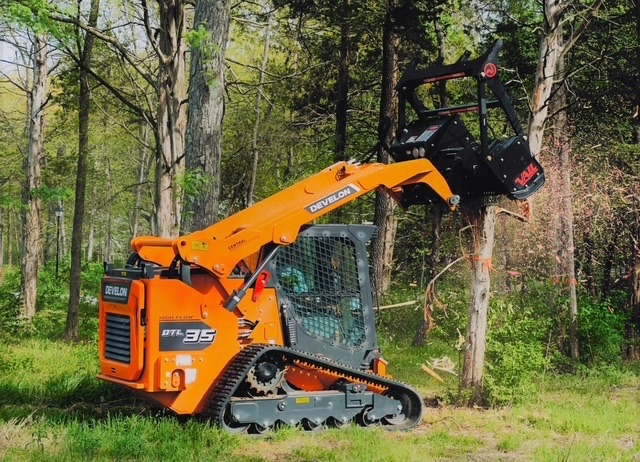
We run a Develon DTL35 with a VAIL X-series mulcher head. For brush clearing specifically, the mulcher beats any bush-hog-type rotary because it grinds woody material instead of knocking it down and leaving stalks. The operator can work up to a fence, around a pond edge, or along a culvert without the drift or debris problem you get with a tractor and PTO rig.
Compared to the other ways to do this
Brush clearing vs. bush hogging
A bush hog cuts soft grass and top growth. A mulcher grinds woody material top-to-ground including surface root crowns. For real brush invasions, a bush hog is a band-aid.
Brush clearing vs. chemical spray
Spray takes a full season and only works on species that are susceptible. Mulching is immediate and species-agnostic. Both tools have a place — most landowners use mulching for the first clear and spray for spot follow-up.
Brush clearing vs. hand work
A chainsaw crew on an acre of Gambel oak is a week of misery. A mulcher is a few hours. For anything over a quarter-acre of real brush, hand work isn't competitive.
Related Services
Forestry Mulching
One machine. One pass. No burn piles, no torn-up soil.
Land Clearing
Trees, brush, undergrowth — cleared in one pass. No burn piles, no haul-off.
Scrub Oak & Gambel Oak Removal
Thin it or clear it. The oak brush that owns the benches, gone in one pass.
Brush Clearing across the Wasatch Front
We bring brush clearing to landowners across the Salt Lake Valley and the Wasatch Front from our base in West Jordan, UT.
Frequently Asked
Ready to Walk Your Land Again?
Send us photos and rough acreage. We come look, give you a flat quote, and put you on the schedule. Free, fast, no pressure.
Serving Salt Lake County, northern Utah County, Tooele County, and the greater Wasatch Front