
Fire Mitigation & Defensible Space Clearing in Utah
Utah's WUI codes are in force and the fees are real. We do the clearing side: fuel modification zones, ladder-fuel thinning, and fuel breaks — cut to your city's standard and documented with photos.
Quick Answer
Utah's WUI codes are in force and the fees are real. We do the clearing side: fuel modification zones, ladder-fuel thinning, and fuel breaks — cut to your city's standard and documented with photos.
The rules changed on January 1
Since January 1, 2026, Utah cities and counties have adopted wildland-urban interface codes and risk maps under HB 48. If your home maps high-risk, you pay a state fee — and completing the mitigation work on your lot assessment is what brings it down. We're the clearing crew for that work: fuel reduction, crown spacing, ladder fuels, mulched in place and documented with photos.
Here's where Utah's wildfire rules stand. Under HB 48, every city and county adopted WUI building and landscaping codes and WUI maps by January 1, 2026. Homeowners mapped high-risk pay a state fee — a flat $20 to $100 (based on square footage) in 2026 and 2027, moving to risk-based fees from 2028. Completing the mitigation actions in your lot assessment reduces that fee. Insurers are required to use the WUI boundary too. First step for any of this: check your address at wildfirerisk.utah.gov.
On the vegetation side, the code standard is concrete: a minimum 30-foot fuel modification zone around structures (or to your lot line, whichever comes first) and 10-foot spacing between tree crowns. The fuels that matter on the Wasatch Front are the ones we grind every week — Gambel oak thickets, juniper, big sagebrush, and the cheatgrass that carries fire between all of them.
What we actually do: cut fuel modification zones around homes and cabins, thin ladder fuels and open up crown spacing so a ground fire can't climb, run fuel breaks along property and subdivision edges, and knock down oak, juniper, and sagebrush across the lot. Everything grinds into mulch where it stands — no burn piles, which matters twice here, because a slash pile is stored fuel and open burning is restricted along the Wasatch Front most of the year anyway. Before we load up, we photograph the finished work so you have documentation for your records.
And here's what we don't do, so there's no confusion: we are not NFPA-certified wildfire mitigation assessors. We don't do home hardening — vents, roofing, siding, decks — we don't do prescribed burns, and we don't do insurance consulting. Your city's WUI code and your lot assessment define what's required. We do the clearing work to that standard, and we document it with photos. If your project needs the assessment or home-hardening side, we'll tell you straight and you can pair us with the right people.
How We Do It
Cut to the standard
The 30-foot fuel modification zone and 10-foot crown spacing your city's WUI code calls for — that's the spec we work to, not a guess.
Mulch in place, no burn piles
A slash pile is stored fuel sitting next to your house, and open burning is restricted along the Wasatch Front most of the year. Everything grinds to chips where it stands.
Photo documentation
Before-and-after photos of the finished work, sent to you before we leave. Paperwork-ready for your own records.
Clearing only — and we say so
No home hardening, no assessments, no prescribed burns. We do the vegetation work and we'll tell you what to pair us with for the rest.
When landowners call us for fire mitigation & defensible space
- 30-foot fuel modification zones around homes and cabins
- Ladder-fuel removal and crown-spacing thinning in the trees you're keeping
- Fuel breaks along property lines and subdivision edges
- Gambel oak knockdown on bench and foothill lots
- Juniper and sagebrush thinning on high-risk ground
- Completing the vegetation items on a WUI lot assessment
- HOA and community fuel-reduction projects
- Maintenance passes that keep defensible space defensible
How the job runs
Check your map and your assessment
Look up your address at wildfirerisk.utah.gov and check your city's WUI page. If you've had a lot assessment, have it handy — it lists the mitigation actions that reduce your fee.
Walk the lot with us
Free on-site walk. We flag the fuel modification zone, the keeper trees, and the thinning cuts, and we'll tell you honestly if any part of your assessment is outside our scope.
Flat quote, on the schedule
You get a locked flat price for the clearing work. Pick a window and we show up when we say we will.
One-pass clearing
Ladder fuels out, crowns spaced, zone cut, brush ground into mulch where it stands. Keeper trees stay untouched.
Photo documentation
We photograph the finished work before we load up and send you the set — before and after — for your records.
What it costs, and why
Small defensible-space jobs — a fuel modification zone around a single home — usually price hourly at $300/hr with a 3-hour minimum, or $2,300 for a full 8-hour day, because the footprint is small and the work is careful. Larger thinning jobs and fuel breaks price per acre in our standard brackets: light ($1,000-$1,750/acre), medium ($1,750-$2,750/acre), and heavy ($2,750+/acre) for steep, rocky, or dense ground. We walk the lot free and lock the quote flat either way.
Why the equipment matters
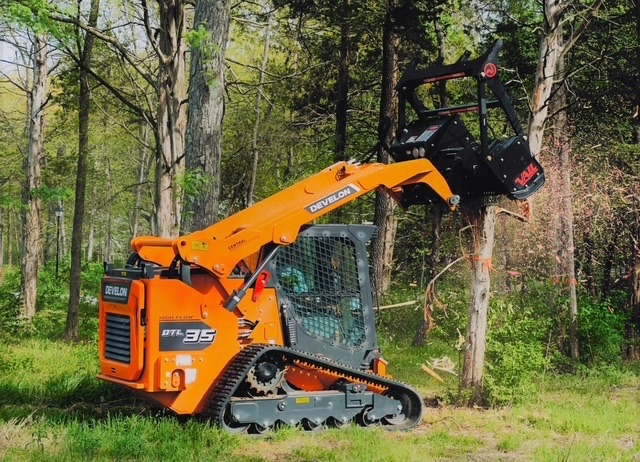
We run a Develon DTL35 compact track loader with a VAIL X-series mulcher head — comfortable on material up to 8 inches and 10 inches when density allows, which covers nearly all the Gambel oak and most of the juniper on high-risk ground. Defensible-space work happens close to structures, so the operator works deliberately near houses, decks, fences, and propane tanks — no flying-chip surprises. The operator has over a decade of seat time, including two years running equipment in Antarctica, seven years of custom harvest from Texas to Canada, and pipeline construction.
Compared to the other ways to do this
Mulch-in-place vs. cut-and-burn
Chainsaw crews leave slash piles that sit as stored fuel while you wait for a burn window that may not come — open burning is restricted along the Wasatch Front most of the year. Mulching grinds the fuel into chips the same day. Nothing stacked, nothing waiting to burn.
Mulched fuel break vs. dozer line
A dozer line strips the slope to bare dirt, which erodes and comes back as cheatgrass — the worst fine fuel there is. A mulched break knocks down the woody fuel and leaves the soil covered in chips.
A clearing crew vs. a full mitigation firm
Certified mitigation specialists assess, plan, and harden structures. We're the equipment side: the crew that actually cuts the fuel to the standard. If you need the assessment and paperwork end, pair us with a certified assessor — we're happy to work off their plan.
Related Services
Forestry Mulching
One machine. One pass. No burn piles, no torn-up soil.
Land Clearing
Trees, brush, undergrowth — cleared in one pass. No burn piles, no haul-off.
Scrub Oak & Gambel Oak Removal
Thin it or clear it. The oak brush that owns the benches, gone in one pass.
Fire Mitigation & Defensible Space across the Wasatch Front
We bring fire mitigation & defensible space to landowners across the Salt Lake Valley and the Wasatch Front from our base in West Jordan, UT.
Frequently Asked
Ready to Walk Your Land Again?
Send us photos and rough acreage. We come look, give you a flat quote, and put you on the schedule. Free, fast, no pressure.
Serving Salt Lake County, northern Utah County, Tooele County, and the greater Wasatch Front