
Vegetation Management for Utilities, HOAs & Municipalities
Scheduled, documented vegetation control for corridors, common areas, and property portfolios across the Wasatch Front. One operator, one machine, one point of contact.
Quick Answer
Scheduled, documented vegetation control for corridors, common areas, and property portfolios across the Wasatch Front. One operator, one machine, one point of contact.
Vegetation control that runs on a schedule
Vegetation management is the standing version of what we do everywhere else on this site: brush, oak, Russian olive, and weeds controlled on a schedule instead of after they've become a problem. It's built for organizations that own linear ground or shared ground — utility and irrigation corridors, HOA common areas, municipal open space, industrial yards — where the question isn't whether the vegetation comes back, but who's responsible when it does.
The Wasatch Front makes this work urgent in a way most regions don't. Utah's WUI rules put fuel-load responsibility on whoever owns the ground, and an HOA's common-area hillside of Gambel oak or a city's cheatgrass drainage is exactly the kind of fuel the codes are aimed at. Community-scale fuel reduction is also where state and federal preparedness money flows — through cities, counties, and HOAs rather than individual homeowners — which means boards and public works departments are increasingly the ones putting this work out for bid.
We're built for that buyer. One operator-owned machine means one point of contact, a certificate of insurance on file before work starts, date-stamped photo documentation of every visit, and a schedule that gets honored. We quote per acre for defined projects, and as a seasonal or annual contract for ground that needs recurring passes.
How We Do It
Insured and documented
COI on request before any work starts. Every visit gets date-stamped photos — the record your board, city, or compliance file actually needs.
Recurring by design
Oak resprouts, cheatgrass cures every summer, Russian olive keeps coming up the ditch. We price the cycle, not just the first pass.
One point of contact
You deal with the operator who runs the machine — not a sales office, not a rotating crew.
Handles woody material
A mowing contractor stops at soft growth. A forestry mulcher takes brush and standing stems up to 8 inches in the same pass.
When landowners call us for vegetation management
- Utility, pipeline, and irrigation corridors on a maintenance cycle
- HOA common areas, open-space parcels, and community fuel breaks
- Municipal open space, trail edges, and drainage channels
- Canal and ditch bank clearing — Russian olive and Siberian elm control
- Solar sites, substations, and industrial yards
- Developer open-space and detention-basin maintenance obligations
- Weed-ordinance compliance across a portfolio of lots
- Shared-boundary fuel reduction between subdivisions and open foothill ground
How the job runs
Walk the ground
We look at the corridor or parcels with you, flag constraints, and confirm what standard the work has to meet — width, height, species to keep, code requirements.
Fixed scope, flat price
Per-acre for defined projects, seasonal or annual pricing for recurring ground. The number is agreed before the machine moves.
Work the schedule
We hit the window you give us and work around residents, irrigation schedules, and site access. If a window can't be hit, you hear it from us early.
Document and repeat
Date-stamped photos after every visit, and a recommended re-treatment interval so nothing gets away from you between passes.
What it costs, and why
Defined projects price per acre using the same brackets as our clearing work: light growth $1,000–$1,750/acre, medium $1,750–$2,750/acre, heavy $2,750+/acre. Recurring maintenance ground runs far cheaper per pass — roughly $300–$700 per acre once the initial knockdown is done — which is what makes seasonal and annual contracts pencil. Small recurring visits run on the hourly structure at $300/hr with a 3-hour minimum.
Why the equipment matters
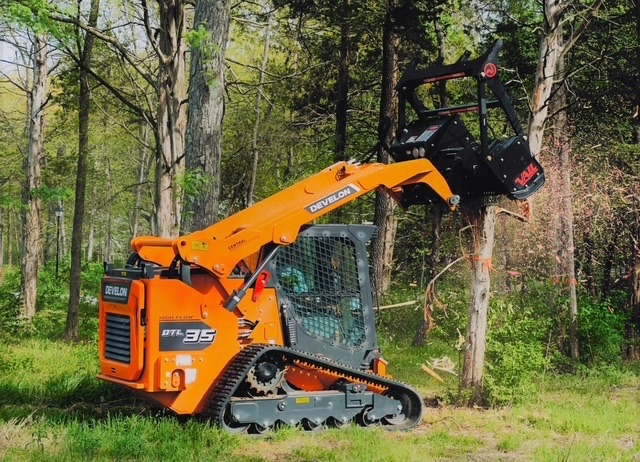
We run a Develon DTL35 compact track loader with a VAIL X-series mulcher head — handles standing material up to about 8 inches, works slopes and tight corridors, and leaves ground mulch instead of windrows or burn piles. Open burning is heavily restricted along the Wasatch Front, so grind-in-place isn't just cleaner — for most managed ground it's the only practical disposal there is.
Compared to the other ways to do this
vs a mowing contractor
Mowers handle grass. The moment a corridor has woody stems — olive, elm, oak, juniper — a rotary mower bogs, skips it, or breaks. The mulcher takes all of it in one pass.
vs a tree service
Tree crews price by the tree and haul what they cut. On acres of corridor or common area, per-acre mulching with mulch left in place is a different cost class entirely.
vs doing it in-house
A forestry mulcher is a six-figure machine that most HOAs and small districts would run a few weeks a year. Contracting the cycle gets the result without owning the iron.
Related Services
Forestry Mulching
One machine. One pass. No burn piles, no torn-up soil.
Land Clearing
Trees, brush, undergrowth — cleared in one pass. No burn piles, no haul-off.
Scrub Oak & Gambel Oak Removal
Thin it or clear it. The oak brush that owns the benches, gone in one pass.
Vegetation Management across the Wasatch Front
We bring vegetation management to landowners across the Salt Lake Valley and the Wasatch Front from our base in West Jordan, UT.
Frequently Asked
Ready to Walk Your Land Again?
Send us photos and rough acreage. We come look, give you a flat quote, and put you on the schedule. Free, fast, no pressure.
Serving Salt Lake County, northern Utah County, Tooele County, and the greater Wasatch Front