
Scrub Oak & Gambel Oak Removal on the Wasatch Front
Gambel oak — scrub oak, oak brush, whatever you grew up calling it — turns a bench lot into a ten-foot wall. We thin it, clear it, or cut it back to your city's fire standard. Mulched in place, no burn piles.
Quick Answer
Gambel oak — scrub oak, oak brush, whatever you grew up calling it — turns a bench lot into a ten-foot wall. We thin it, clear it, or cut it back to your city's fire standard. Mulched in place, no burn piles.
The brush that owns the benches
Gambel oak is the low, thicket-forming oak that covers the benches and foothills from Draper to Alpine to Emigration Canyon. It spreads from a connected root system, so one clump becomes a thicket and a thicket becomes a wall. We grind it into mulch in one pass — full removal, selective thinning, or a fuel-modification cut around structures. Your call.
Gambel oak is clonal. What looks like a hillside of separate trees is usually one organism — hundreds of stems sharing a root system, each clump pushing outward a little every year. That's why a bench lot with scattered oak brush ten years ago is solid today, and why mowing and chainsaw work never get ahead of it. Cut a stem and the roots just send up more.
People call us about scrub oak for four reasons: fire, ground, views, and access. Oak thickets with cheatgrass filling in underneath are the main wildfire fuel on the benches. Thicket ground is unusable ground — you can't walk it, plant it, or build on it. And on hillside lots, the oak takes the view and closes the paths first.
You don't have to take all of it. Selective thinning is where a mulcher earns its keep: we grind out the thicket and thread around the healthy clumps you want kept — for screening between houses, for wildlife, for holding a slope. A dozer can't do that. It takes everything in the blade's path, roots and topsoil included, and on bench slopes that's an erosion problem you'll be fixing for years.
Here's the honest part: Gambel oak comes back. The Forest Service has documented resprouting within about three years of mastication. Anyone who tells you one pass kills it is selling something. The way you win is a maintenance cycle — an annual or every-other-year pass at a fraction of the first-clear cost that grinds the resprouts before they harden off. Our land management plans are built for exactly this.
And sometimes the right answer is to leave it. Healthy oak on a steep slope is holding that slope. A clump between you and the neighbors is free screening. Deer browse it and bed in it. We'll tell you during the walk which patches are working for you — we'd rather thin smart than clear big.
How We Do It
Thin or clear — your call
Full removal, selective thinning, or a cut around structures. We flag keeper clumps with you and thread around them.
Mulched in place
The oak grinds into chips where it stands. No burn piles — a real advantage where Wasatch Front air-quality rules keep open burning off the table most of the year.
Cut to the fire standard
Where the job is defensible space, we cut to your city's WUI code — the 30-foot fuel modification zone and 10-foot crown spacing. See our fire mitigation service for the full picture.
Honest about regrowth
Gambel oak resprouts — within about three years of mastication, per the Forest Service. We set up maintenance cycles so it never gets tall again.
When landowners call us for scrub oak & gambel oak removal
- Bench and foothill lots where the oak has grown into a wall
- Fuel reduction and defensible-space cuts around homes near the foothills
- Selective thinning that keeps screening and shade clumps standing
- View corridors on hillside and canyon-mouth lots
- Access lanes and trails punched through oak thickets
- Yard and pasture edges the oak has crept into
- Pre-listing clears on oak-choked parcels
- Maintenance passes on previously cleared oak ground
How the job runs
Send photos and a rough footprint
A few pictures of the thicket and a guess at the area. Oak brush is easy to read from photos — we'll give you a ballpark fast.
Walk it and flag it
Free on-site walk. We decide together what's a full clear, what's a thin, and which clumps stay for screening, wildlife, or slope stability. Quote comes flat.
One-pass mulching
The mulcher grinds stems, canes, and surface root crowns into chips. Keeper clumps stay untouched. No burn pile, no haul-off.
Set the maintenance cycle
Oak resprouts, so most customers lock in an annual or every-other-year pass. Cheaper than a fresh clear and the thicket never gets a foothold again.
What it costs, and why
Scrub oak removal is priced per acre with a flat quote, in the same three brackets as our other clearing work: light ($1,000-$1,750/acre) for scattered oak brush on gentle ground; medium ($1,750-$2,750/acre) for established thickets on 10-20% slopes — where most Gambel oak jobs land; and heavy ($2,750+/acre) for dense, mature oak on 20+% slopes and rocky ground. Small cuts and odd-shaped jobs can go hourly at $300/hr with a 3-hour minimum, or $2,300 for a full 8-hour day. Maintenance passes after the first clear run a fraction of the fresh-clear rate.
Why the equipment matters
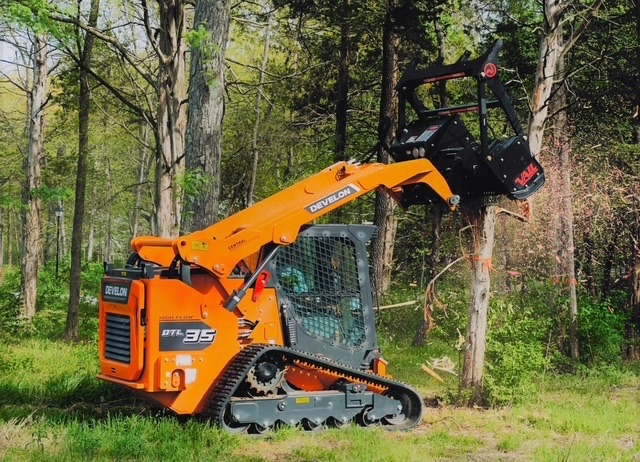
We run a Develon DTL35 compact track loader with a VAIL X-series mulcher head — comfortable on material up to 8 inches and 10 inches when density allows, which covers nearly every Gambel oak stem on the Wasatch Front. Oak country means slopes and rock: the tracks spread the machine's weight on grades, and we carry spare carbide teeth because bench ground eats them. The operator has over a decade of seat time, including two years running equipment in Antarctica, seven years of custom harvest from Texas to Canada, and pipeline construction.
Compared to the other ways to do this
Mulching vs. dozer removal
A dozer rips the oak out roots, topsoil, and all — and on a bench slope that's an erosion problem, not a solution. Mulching grinds the stems, leaves the soil under a protective chip layer, and lets you keep the clumps you want. Dozing also can't thin; it's all or nothing.
Mulching vs. herbicide
Spray doesn't touch a standing ten-foot thicket — it's a follow-up tool for resprouts, and it takes seasons to show. We don't spray. Mulching resets the ground mechanically the same day, and if you want chemical follow-up on the regrowth, a licensed applicator can spot-treat behind us.
Mulching vs. chainsaw crews
An acre of mature Gambel oak by hand is a week of misery, a slash pile, and a burn permit you probably can't get. The mulcher does it in hours and leaves mulch instead of slash.
Related Services
Forestry Mulching
One machine. One pass. No burn piles, no torn-up soil.
Land Clearing
Trees, brush, undergrowth — cleared in one pass. No burn piles, no haul-off.
Fire Mitigation & Defensible Space
Fuel modification zones, ladder fuels, fuel breaks — cut to your city's WUI standard.
Scrub Oak & Gambel Oak Removal across the Wasatch Front
We bring scrub oak & gambel oak removal to landowners across the Salt Lake Valley and the Wasatch Front from our base in West Jordan, UT.
Frequently Asked
Ready to Walk Your Land Again?
Send us photos and rough acreage. We come look, give you a flat quote, and put you on the schedule. Free, fast, no pressure.
Serving Salt Lake County, northern Utah County, Tooele County, and the greater Wasatch Front