
Fence Line Clearing for Pastures & Property Lines
Get your fence lines and property boundaries back. Russian olive and Siberian elm bury the wire fast — we clear the line to the post and keep it that way.
Quick Answer
Get your fence lines and property boundaries back. Russian olive and Siberian elm bury the wire fast — we clear the line to the post and keep it that way.
When did you last see the wire?
Fence rows fill in fast out here. Russian olive and Siberian elm seed into any unmowed strip, and a few seasons later the wire is buried in brush you can't walk. We clean fence lines back to the post, leave a corridor you can ride, mow, or re-fence along, and keep your property boundary a boundary instead of a thicket.
Fence lines and ditch banks are where brush wins first. Nobody mows them, water runs along them, and Russian olive and Siberian elm seed in from every direction. A pasture fence that was clean ten years ago is now a wall — you can't check the wire, you can't fix a break without fighting thorns, and the horses lean on posts you can't even see.
On top of the access problem, brush wrecks fence. Limbs load the wire, roots heave the posts, and Russian olive grows right through woven wire until the fence and the tree are one object. Ditch banks and irrigation laterals go the same way — and brush on a lateral steals water and access at the same time.
Our mulcher runs along the fence and grinds the brush back to the post. Clean, straight, walkable. We work around wire, posts, culverts, and gates without damaging them.
How We Do It
Cleared to the post
We work right up to the wire so your tractor has clearance and your fence stays visible.
Usable ground recovered
Every foot of brush we take back is pasture, access lane, or boundary you can actually use.
Equipment-safe
No damage to fence wire, posts, culverts, or gates. We work around them, not through them.
Mile-pricing available
Long fence lines and multi-pasture jobs get priced by the linear mile with volume breaks.
When landowners call us for fence line clearing
- Pasture fence lines where the brush has swallowed the wire
- Russian olive and Siberian elm grown up through fence wire
- Pasture fence cleanup before re-fencing or replacement
- Ditch banks and irrigation laterals clogged with brush
- Multi-year neglected fence rows being reclaimed
- Property-line cleanup for surveys, sales, or new fencing
- Boundary lines on horse properties and ranchettes
- Fence corners and gates grown shut
How the job runs
Aerial look + linear footage
We can estimate most fence line jobs from Google Maps imagery. Send us the parcel and approximate fence length.
Walk and flag
We walk the line, flag any trees you want kept (corners, wind breaks, shade), and quote the job flat.
Clear the corridor
The mulcher runs the line and grinds the brush back to the post. Wire, posts, and culverts stay intact.
Walk the finish
We walk the cleared line with you. Touch-ups are part of the job.
What it costs, and why
Fence line clearing is priced by the acre at $1,200 per acre, or by linear mile for long jobs. A typical cleared corridor is 12 to 15 feet wide. A quarter-mile fence line cleared 15 feet wide works out to about 0.45 acres — roughly a $550–$800 job depending on density. Longer jobs get mile rates.
Why the equipment matters
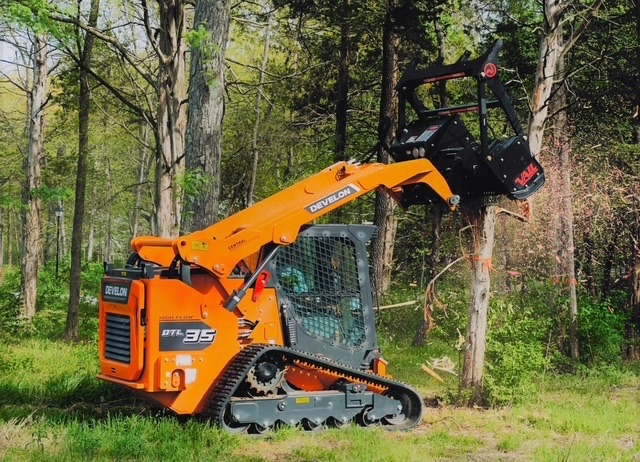
Fence line work takes precision — the operator is running close enough to the wire to buff a post but never touch it. That's what a decade of seat time buys. The machine is a compact track loader with forestry tires and a mulcher head sized for fence line corridor work. We carry spare carbide teeth because fence lines often hide old wire in the brush that we didn't know was there.
Compared to the other ways to do this
Forestry mulcher vs. tractor with batwing
A batwing knocks the top off grass and soft saplings. It doesn't touch a real fence-row thicket — any tree over 2 inches stays standing.
Forestry mulcher vs. bulldozer
A dozer pushes the fence row into a pile and strips topsoil doing it. You're left with a brush pile, a berm, and regrade work before the line is usable.
Forestry mulcher vs. chainsaw crew
Chainsaw crew works a fence line at 50–100 feet per hour with a full team. A mulcher works at 300–600 feet per hour solo, and leaves mulch instead of slash.
Related Services
Forestry Mulching
One machine. One pass. No burn piles, no torn-up soil.
Land Clearing
Trees, brush, undergrowth — cleared in one pass. No burn piles, no haul-off.
Scrub Oak & Gambel Oak Removal
Thin it or clear it. The oak brush that owns the benches, gone in one pass.
Fence Line Clearing across the Wasatch Front
We bring fence line clearing to landowners across the Salt Lake Valley and the Wasatch Front from our base in West Jordan, UT.
Frequently Asked
Ready to Walk Your Land Again?
Send us photos and rough acreage. We come look, give you a flat quote, and put you on the schedule. Free, fast, no pressure.
Serving Salt Lake County, northern Utah County, Tooele County, and the greater Wasatch Front